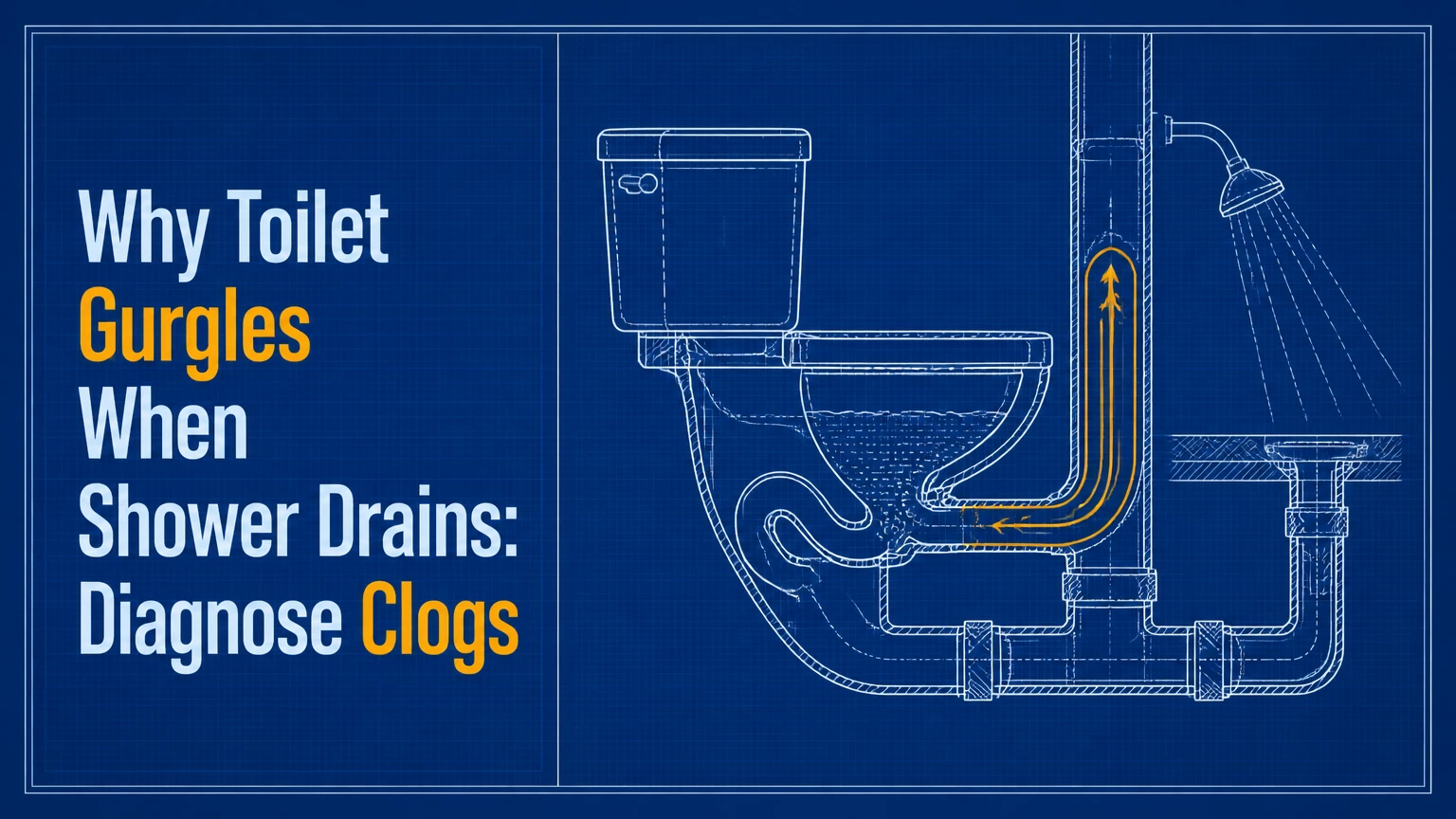
A toilet gurgles when the shower drains because water is moving through a restricted or poorly vented drain-waste-vent system. The shower and toilet may share a branch drain, so escaping air uses the toilet trap as a pressure-release path. The result is bubbling, chugging, or a brief change in toilet-bowl water level.
Key Facts at a Glance
A gurgling toilet usually indicates a drain restriction, blocked vent, or pressure imbalance.
Rising toilet water points more strongly to a downstream blockage than to a simple vent fault.
If sinks, tubs, laundry fixtures, or several toilets also gurgle, suspect a larger building drain or sewer-line problem.
A flange plunger is safer for a toilet than a flat cup sink plunger.
Chemical drain cleaners rarely clear a shared drain or roof vent and can expose occupants and plumbers to corrosive liquid.
Sewage entering the shower, toilet overflow, or rapid backup requires prompt professional attention.
Why Does a Toilet Gurgle When a Shower Drains?
A toilet gurgles when a shower drains because the shower’s discharge changes air pressure in a shared waste pipe, and the pressure cannot equalize normally through the drain or vent. Water may pull air behind itself, creating negative pressure, or push trapped air ahead of a blockage, creating positive pressure. Both conditions disturb the toilet’s water seal.
A plumbing drainage system needs air as well as an open path for wastewater. Drain pipes carry used water toward the building drain, while vent pipes connect the drainage system to outdoor air and limit pressure changes. The International Plumbing Code and Uniform Plumbing Code both use venting requirements to protect trap seals, although local adoption and permitted configurations vary.
The toilet is often the most noticeable fixture because its internal trap contains a visible water seal. Air passing through that seal produces the familiar gulping noise. A shower drain may be the source of the moving water, but the toilet is the pressure indicator.
How the shared DWV system creates the sound
The sequence normally looks like this:
- Shower water enters the bathroom branch drain.
- The moving water meets a partial restriction or poorly vented section.
- Air pressure changes around the water column.
- Air moves through the toilet trap or bowl water.
- The bowl water vibrates, rises, falls, or briefly ripples.
A partial blockage can still let the shower drain, which is why a gurgle may appear before an obvious backup. Hair, soap scale, paper, grease from an adjoining fixture, mineral deposits, invasive roots, or a damaged pipe can all reduce the available cross-sectional area.
How Does Toilet Gurgling Differ From a Normal Plumbing Sound?
Normal drainage is generally quiet apart from a short rush of water. A repeatable gurgle synchronized with shower drainage is abnormal because it shows air crossing a trap seal or moving through a restricted drainage path. One isolated burp after a fixture has been unused is less concerning than recurring noise with slow drains or bowl movement.
The sound’s timing helps locate the fault. A gurgle during shower drainage suggests a shared branch or vent relationship. A gurgle after the shower stops can occur when trapped water continues moving through a restriction. A gurgle when the toilet flushes points toward the same drainage network but does not prove that the toilet itself is blocked.
What does the toilet bowl reveal?
The bowl response provides useful, although not perfect, evidence:
| Bowl behavior during shower drainage | More likely interpretation | Next check | Urgency |
|---|---|---|---|
| Small ripple, no level change | Early pressure imbalance or vent restriction | Run sink and inspect other drains | Low to moderate |
| Water level rises 1-2 cm | Downstream branch restriction | Stop water use and plunge cautiously | Moderate |
| Water rises toward the rim | Significant shared-line blockage | Stop fixtures and call a plumber | High |
| Water level falls noticeably | Siphonage or inadequate vent air | Check vent and nearby fixture traps | Moderate |
| Bubbles with sewage odor | Air and contaminated wastewater movement | Avoid fixture use and arrange service | High |
A rising bowl does not identify the exact blockage location by itself. It does establish that the drainage system is struggling to accept additional flow, especially when the shower pan also begins to collect water.
Is the Problem a Clog or a Blocked Vent?
A clog is more likely when water drains slowly, the bowl rises, several fixtures back up, or the problem worsens as more water enters the system. A blocked vent is more likely when fixtures drain at normal speed but traps gurgle, bowl water fluctuates, and the symptoms affect fixtures connected to the same vent route.
The distinction is probabilistic, not absolute. A partial branch blockage can create pressure symptoms without immediate backup, and a vent defect can coexist with a drain restriction. A plumber may need to test both paths because a visual inspection of one fixture cannot rule out a concealed obstruction.
| Symptom pattern | Branch or main-line clog | Vent restriction | Defective or missing vent |
|---|---|---|---|
| Shower drains slowly | Common | Possible, less typical | Possible |
| Toilet bowl rises | Common | Less typical | Possible |
| Several fixtures affected | Common | Possible | Possible |
| Gurgling with normal drainage | Possible | Common | Common |
| Sewer odor after gurgling | Possible | Possible | Common |
| Water backs into shower | Common | Uncommon alone | Uncommon alone |
| Roof obstruction visible | No | Possible | No |
| Clearing a nearby drain fixes it | Common | Unlikely | Unlikely |
Why can a vent blockage cause gurgling without a slow drain?
A vent blockage can cause gurgling without a slow drain because the drainage pipe may still have enough capacity for wastewater, while the vent cannot admit or release air efficiently. The moving water then draws replacement air through a fixture trap. This often produces noise before visible drainage failure.
Typical vent obstructions include leaves, bird nesting material, a dead animal, snow or ice, construction debris, and a failed vent cap. In cold climates, frost can form inside a vent where warm humid air meets freezing outdoor air. A vent can also be undersized, incorrectly routed, or disconnected inside a wall, defects that roof inspection cannot reveal.
Do not climb onto a wet, steep, icy, or fragile roof to inspect a vent. A licensed plumber can inspect from the attic, use a camera, or test airflow from a safe access point.
Which Blockage Location Matches Your Symptoms?
The most likely location depends on how many fixtures are affected and where wastewater first encounters resistance. A bathroom-only problem usually points toward a local branch or vent, while simultaneous trouble throughout the home increases concern about the building drain, sewer lateral, or septic outlet.
A branch drain carries wastewater from a group of nearby fixtures before joining a larger stack or building drain. If the shower and toilet connect on the same bathroom branch, a restriction after their connection can make one fixture react when the other discharges.
| Affected area | Likely location | Typical evidence | Common access point |
|---|---|---|---|
| Shower and toilet only | Bathroom branch | Local gurgle, slow shower | Shower trap, branch cleanout |
| Bathroom plus nearby sink | Branch or vent stack | Sink drainage changes bowl | Lavatory trap or cleanout |
| Upstairs and downstairs fixtures | Building drain | Multiple simultaneous symptoms | Main cleanout |
| Entire house | Sewer lateral or septic outlet | Several backups, outdoor cleanout level | House sewer cleanout |
| One toilet alone | Toilet trap or short branch | Flush is weak or bowl stays high | Toilet auger opening |
| Intermittent upper-floor symptoms | Vent, stack, or partial branch | Weather or usage changes symptoms | Roof vent, attic, stack |
Tree roots deserve special attention in older properties. Roots can enter joints in buried clay, concrete, or cast-iron sewer lines and create recurring restrictions. Hydro jetting may remove roots temporarily, but a camera inspection is needed if the roots return.
What Should You Do First?
Start by stopping unnecessary water use, documenting the symptom, and checking whether the problem is local or widespread. The safest first intervention is a properly sealed flange-plunger attempt on the toilet, provided the bowl is not already near overflowing and no chemical cleaner has been added.
Before you start
| Item | Typical requirement | Purpose |
|---|---|---|
| Diagnostic time | 10-15 minutes | Compare fixtures and bowl movement |
| Flange plunger | 1 toilet-specific tool | Creates a seal in the bowl outlet |
| Rubber gloves | 1 pair | Protects hands from contaminated water |
| Towels or plastic sheet | 2-4 towels | Limits splash and floor contamination |
| Plunging cycles | 2-3 cycles of 10-15 strokes | Tests a nearby soft restriction |
| DIY cost | $8-$25 typical US retail | Covers a basic plunger and gloves |
Step 1: Test the bathroom fixtures
Run the bathroom sink for 30-60 seconds, then flush the toilet once if the bowl is at its normal level. Ask someone to watch the toilet while water drains. Avoid running the washing machine or bathtub during this first test because a severe blockage can turn a diagnostic check into a backup.
Record whether the shower drains quickly, whether the toilet bubbles, and whether the sink drain makes a sucking sound. Then check a fixture on another floor, if present. A symptom confined to one bathroom supports a branch or local vent diagnosis; symptoms in several rooms support a building drain or main-line diagnosis.
Success checkpoint: only the shower-toilet combination produces a sound, with no rising water.
Common mistake: repeatedly flushing to “test” the system after the bowl begins rising.
Step 2: Plunge the toilet correctly
Add enough water to cover the rubber flange if the bowl level is low. Place the flange fully over the toilet outlet, press down gently to remove air, and complete 10-15 controlled strokes without breaking the seal. Lift the plunger slowly and wait 30 seconds before testing with a small flush.
A flat cup plunger often leaks around the toilet outlet and transfers little pressure to the branch line. A toilet auger is a better tool when the toilet itself is blocked, but it may not reach a restriction farther along the shared drain.
Success checkpoint: the shower drains without a gurgle and the bowl remains stable during a test flush.
Common mistake: plunging violently, which can splash contaminated water or damage a weak wax seal.
Step 3: Seal nearby openings only when appropriate
If plunging produces bubbles in the shower drain, cover the shower drain with a wet rag or a drain test plug and cover the sink overflow opening with tape. The goal is to reduce pressure loss through nearby openings while using the flange plunger.
Do not create high pressure in a system that contains chemical drain cleaner. Do not seal fixtures if water is already backing up rapidly, because pressure and contaminated water can move unpredictably. Stop after two or three controlled attempts if the symptom remains.
Success checkpoint: plunging changes the bowl response or improves drainage without leakage around the toilet base.
Common mistake: using compressed-air bladder devices inside an indoor fixture without knowing the pipe layout.
Which Repair Method Fits the Fault?
Manual plunging fits a suspected nearby soft blockage, while mechanical cable cleaning fits a persistent restriction accessible through a cleanout. Vent clearing requires safe access and a confirmed vent problem, and hydro jetting is better reserved for heavy scale, grease, or roots in sound pipework.
| Method | Typical US cost | Typical duration | Best use | Main limitation |
|---|---|---|---|---|
| Flange plunger | $8-$25 DIY | 5-15 minutes | Nearby soft blockage | Limited reach |
| Toilet auger | $25-$80 tool | 15-30 minutes | Toilet trap obstruction | Does not clean a branch line |
| Drain cable service | $150-$450 | 1-3 hours | Branch or main restriction | May leave scale or roots |
| Camera inspection | $150-$500 | 30-90 minutes | Recurrent or concealed faults | Diagnoses, but does not clear |
| Hydro jetting | $500-$1,500 | 2-4 hours | Grease, scale, or roots | Riskier in fragile pipe |
| Vent repair or clearing | $150-$600 | 1-4 hours | Confirmed vent fault | Roof and wall access can add cost |
These are typical US residential ranges, not fixed prices. Labor rates, access, city requirements, pipe material, after-hours service, and whether excavation is needed can change the final invoice substantially.
Why are chemical drain cleaners a poor choice?
Chemical drain cleaners are a poor choice for a gurgling toilet because the liquid may not reach a downstream restriction, cannot clear a roof vent, and remains hazardous if a plumber later opens the line. Sodium hydroxide and sulfuric-acid products can cause burns, damage some materials, and generate heat when reacting with organic matter or standing water.
Chemical products also make diagnosis harder. A plumber must know whether the line contains caustic or acidic residue before using a cable or opening a trap. Never mix drain chemicals with bleach, toilet cleaner, or another drain product, because dangerous vapors or reactions can result.
When is a camera inspection justified?
A camera inspection is justified when the gurgling returns after clearing, multiple fixtures are affected, roots are suspected, the property has old buried piping, or a cable passes without restoring normal flow. A camera identifies recurring structural causes such as offset joints, cracks, collapsed pipe, heavy scale, and root intrusion.
A camera is not always the first step for a single mild episode. If a local plunge permanently restores drainage and no other fixture reacts, observation may be reasonable. Repeated symptoms are different because temporary flow does not prove that the pipe is structurally sound.
When Is a Gurgling Toilet Urgent?
A gurgling toilet is urgent when wastewater rises in the shower, the toilet approaches overflow, sewage odor appears, several fixtures back up, or water emerges from a floor drain. Stop using toilets, showers, sinks, washing machines, and dishwashers until the drainage path is assessed.
| Warning sign | Immediate action | Why it matters |
|---|---|---|
| Sewage in shower pan | Stop all water use | Contamination can spread across flooring |
| Toilet water near rim | Close the toilet supply valve | Prevents another automatic refill |
| Multiple drains backing up | Call a drain professional | Main-line restriction is likely |
| Outdoor cleanout overflowing | Keep people and pets away | Sewage may contain pathogens |
| Repeated problem after snaking | Request camera inspection | Structural damage may remain |
| Chemical cleaner already used | Tell the plumber before service | Prevents chemical exposure |
Sewage backup can damage flooring, subflooring, drywall, and personal belongings. Porous materials that absorb contaminated water may require specialized cleaning or replacement, depending on local public-health guidance and insurance requirements.
Why Does Gurgling Happen Only Sometimes?
Intermittent gurgling occurs when flow, temperature, occupancy, or blockage position changes the pressure inside the drainage system. A partial obstruction may pass small shower flows but resist a longer shower, while a vent may behave differently during cold weather, heavy rain, or wind.
Common intermittent scenarios include a washing machine discharge that triggers the sound only on the drain cycle, a second-floor shower that affects a lower toilet, and a septic system that gurgles when the tank or outlet filter approaches a service threshold. In an apartment, the restriction may be in a shared stack outside the unit.
Weather can expose vent defects. Ice, snow, or leaves may temporarily obstruct a roof termination, then clear as temperatures change. A recurring seasonal pattern deserves inspection rather than repeated plunging.
What changes in a septic-system home?
A septic-system home requires consideration of the tank, outlet baffle, effluent filter, distribution box, and soil absorption area when several fixtures gurgle or drain slowly. A bathroom branch clog remains possible, but a full tank or blocked outlet can affect the whole property.
Do not open a septic tank casually. Tank gases can be dangerous, and falls into an open tank are fatal hazards. Contact a septic professional when the tank-pumping interval is overdue, wastewater appears near the tank or drain field, or several household fixtures show reduced drainage.
What changes in an apartment?
An apartment resident should treat widespread or recurring gurgling as a building-maintenance issue after a basic observation, not as a reason to open shared plumbing. Report the time, fixtures affected, bowl movement, backup location, and any odor to the landlord or property manager.
Do not access the roof, use aggressive chemicals, or snake a shared stack without written authorization. A neighboring unit’s discharge can trigger symptoms in your bathroom, and only building maintenance can test the common stack and downstream building drain properly.
What Do Plumbers Check That Homeowners Cannot?
Plumbers distinguish a branch blockage from a vent or sewer fault by testing flow at multiple access points, measuring drainage behavior, inspecting cleanouts, and using cameras or specialized locating equipment. A professional diagnosis is valuable when the visible fixture is only the first place where pressure becomes audible.
Typical professional checks include:
- Testing the main cleanout for standing water.
- Running a controlled fixture test while observing another trap.
- Using a closet auger for the toilet trap.
- Cabling the branch line from an appropriate cleanout.
- Inspecting buried sewer piping with a camera.
- Checking vent continuity from the roof, attic, or wall.
- Verifying a septic tank, outlet filter, or pump where applicable.
A plumber should explain which access point they used and whether the cable reached the suspected restriction. Ask whether the quoted price includes a camera inspection, cleanup, and a return visit if the same blockage recurs.
Common Mistakes and How to Correct Them
Mistake 1: Treating every gurgle as a toilet clog
A toilet auger reaches the toilet trap, not necessarily the branch connection beyond the toilet. If the toilet flushes normally but the shower triggers bubbling, investigate the shared drain and vent relationship instead of repeatedly augering the bowl.
Mistake 2: Ignoring a small bowl movement
A one-centimeter rise can precede a larger backup when the restriction worsens. Reduce water use, record the symptom, and arrange service if the bowl movement repeats during ordinary shower drainage.
Mistake 3: Flushing a roof vent with a hose without a safety plan
Water entering a blocked vent can spill into the attic or reveal a disconnected pipe inside the building. Roof work also carries fall risk. Use a professional when roof access is unsafe or the vent cannot be inspected from ground level.
Mistake 4: Assuming hydro jetting is always superior
Hydro jetting cleans aggressively, but high pressure can worsen defects in brittle clay, heavily corroded cast iron, or damaged lines. A camera assessment should precede jetting when roots, collapse, or old pipe material are possible.
Mistake 5: Replacing a vent with an air admittance valve automatically
An air admittance valve, or AAV, admits air under negative pressure but does not release positive pressure in every configuration. Local plumbing codes may restrict its use, and an AAV cannot clear a blocked drain or repair a disconnected vent. A licensed plumber should verify the permitted application.
How Much Does Repair Usually Cost?
A simple local blockage may cost $100-$300 for professional clearing, while a main-line camera inspection and cleaning commonly total $300-$900 before structural repair. Vent repairs often cost $150-$600, but roof complexity, wall opening, replacement piping, and regional labor rates can raise the figure.
| Repair scenario | Typical US total | Typical service time | Possible extra |
|---|---|---|---|
| Toilet trap cleared | $100-$250 | 30-90 minutes | Replacement wax ring |
| Bathroom branch cleared | $150-$450 | 1-3 hours | Cleanout installation |
| Main line cleaned | $250-$700 | 1-4 hours | Camera inspection |
| Camera plus diagnosis | $150-$500 | 30-90 minutes | Locating or report |
| Roof vent cleared | $150-$400 | 1-2 hours | Roof access equipment |
| Damaged sewer lateral | $2,000-$15,000+ | 1-5 days | Excavation, permits, restoration |
These figures describe typical residential service in the United States and exclude emergency premiums in many markets. A recurring clog that costs $250 to clear several times can justify a camera inspection because the repeated service may conceal a broken or root-filled line.
FAQ
Can a shower drain and toilet be connected to the same pipe?
Yes, a shower and toilet can connect to the same properly sized and vented bathroom branch drain. The connection must comply with the plumbing code adopted in the property’s jurisdiction, including pipe sizing, slope, venting, cleanouts, and fixture distances. Shared piping is normal; gurgling indicates that the system may not be functioning normally.
Will flushing the toilet clear the shower drain?
Flushing the toilet will not reliably clear a shower drain. A toilet flush adds a large water volume to the same drainage network and can worsen a downstream restriction, causing wastewater to rise in the shower pan. Use controlled plunging only when the bowl is stable and no chemical cleaner is present.
Can a blocked shower trap cause the toilet to gurgle?
A blocked shower trap alone usually causes slow shower drainage rather than toilet gurgling. If the obstruction is beyond the shower trap where the shower and toilet branches meet, pressure can travel through the toilet trap and create the sound. Hair at the shower grate normally does not explain a distant toilet reaction.
Why does the toilet gurgle when the washing machine drains?
A washing machine discharges water rapidly, so it can expose a restricted main drain or inadequate vent that a slow sink flow does not reveal. If the toilet gurgles when the washing machine drains and several fixtures are slow, stop using the machine and arrange a main-line evaluation.
Can rain cause a toilet to gurgle?
Rain can coincide with toilet gurgling when leaves, ice, or debris obstruct a roof vent, or when a combined sewer or overloaded drainage system receives additional flow. Rain alone should not make a properly operating private DWV system gurgle. Repeated weather-linked symptoms justify vent and sewer inspection.
The Bottom Line
The reason a toilet gurgles when a shower drains is usually a pressure imbalance caused by a partial shared-drain blockage, a main-line restriction, or a venting fault. Test other fixtures, watch the bowl, and try limited flange plunging only when no overflow or chemical hazard exists. Stop water use and call a professional when sewage backs up, multiple fixtures are affected, or the gurgle returns after clearing.