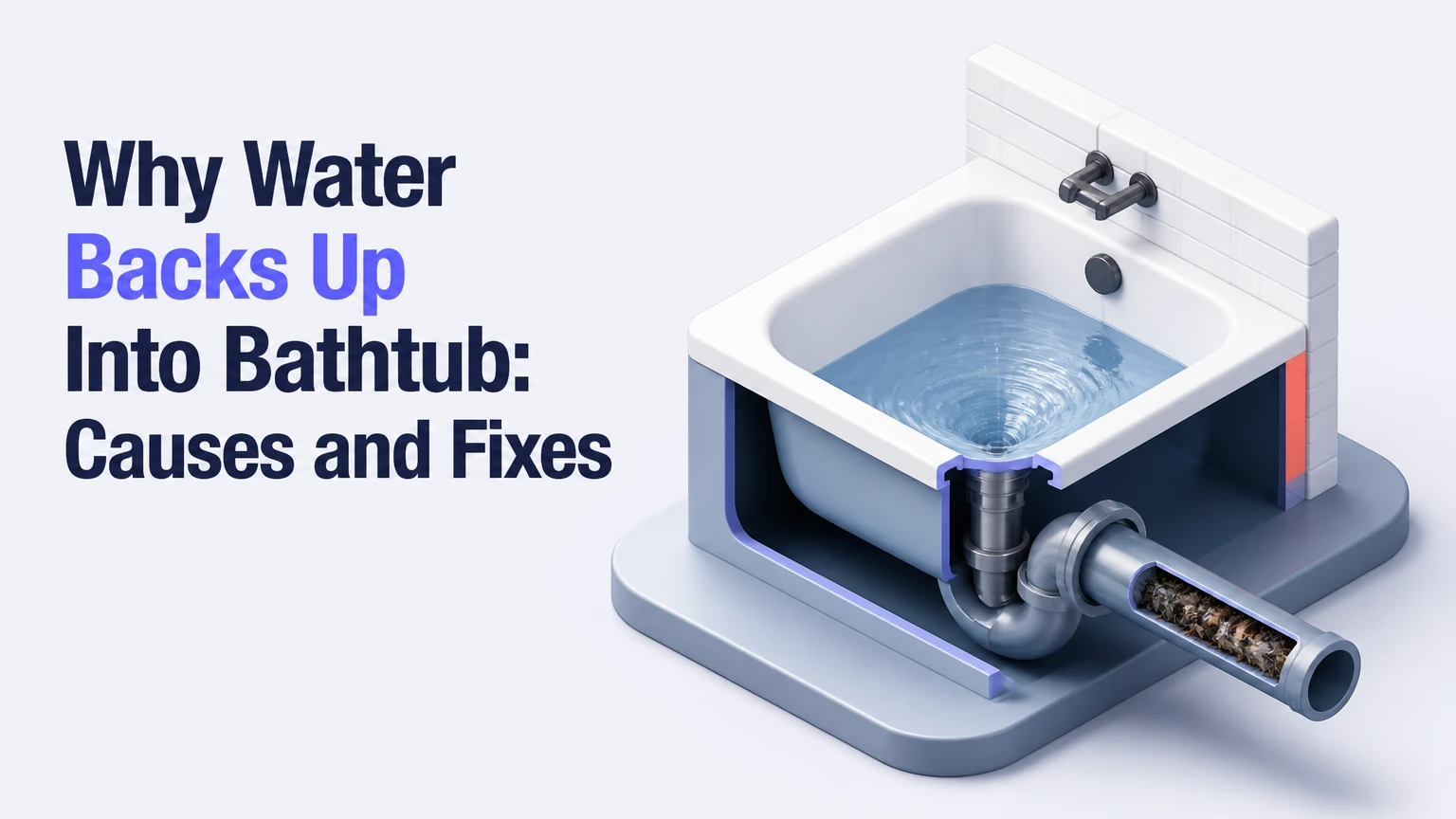
Water backs up into a bathtub because a blockage, damaged pipe, full septic system, or municipal sewer restriction prevents wastewater from leaving the home. The bathtub is often the lowest open fixture, so water discharged by a toilet, washing machine, sink, or shower can reverse through the tub drain before it reaches higher fixtures.
Key Facts at a Glance
A tub that backs up only while its own faucet runs usually has a local drain or trap obstruction.
A tub that rises when a toilet flushes or a washing machine drains usually indicates a shared branch or main sewer blockage.
Sewage-colored water, repeated backups, or multiple slow fixtures require immediate water-use reduction and professional diagnosis.
A blocked vent can cause gurgling and slow drainage, but a substantial wastewater rise usually involves a restricted drain or sewer line.
A sewer camera inspection should precede hydro jetting or structural repair when roots, corrosion, collapse, or a recurring blockage is suspected.
Typical U.S. professional drain clearing costs about $150-$500; pipe replacement costs far more because excavation and surface restoration may be required.
Why Water Backs Up Into Bathtub
A bathtub backup occurs when wastewater reaches a restriction downstream of the tub connection and cannot continue toward the building sewer. Water then rises through the lowest practical opening, commonly the tub or shower drain, because those fixtures sit lower than sinks and have no mechanical backflow barrier.
Residential drainage depends on gravity, adequate pipe slope, open pipe capacity, and balanced air pressure. A normal route is fixture drain to trap, bathroom branch, larger building drain, sewer lateral, and finally the public sewer or septic tank. The exact layout varies by house age and local plumbing code.
The bathtub is not necessarily the location of the blockage. It is often the visible outlet. A restriction several feet away, beneath a slab, in the yard, inside a septic tank inlet, or in the municipal sewer can produce the same symptom.
Why Does a Toilet Flush Make the Tub Fill?
A toilet flush makes the bathtub fill when the toilet and tub share a restricted downstream drain. The flush sends a large volume of water through the branch or building sewer, and the trapped flow displaces air and wastewater toward the tub opening.
A brief gurgle without rising water can indicate an early restriction or venting problem. Water that visibly rises, especially gray or brown water, indicates that the drainage system has less usable capacity than the incoming discharge. Stop flushing and avoid running faucets until the problem is localized.
How Does the Backup Reach the Tub?
Wastewater reaches the bathtub through the shared drain network when a downstream restriction blocks normal flow. The sequence is straightforward:
- Hair, grease, scale, roots, wipes, or a damaged section narrows the pipe.
- Water from an upstream fixture meets the restriction.
- Continued discharge fills the available pipe volume.
- Air and wastewater move toward an open fixture with lower resistance.
- The tub drain receives the reverse flow and may overflow.
The common “vacuum” explanation needs qualification. A blocked vent can disrupt pressure equalization, but a drain clog does not usually create a perfect vacuum that independently pulls water into the tub. In most backups, gravity and the incoming wastewater volume create the visible rise while trapped air produces bubbling or gurgling.
What Pipe Details Matter?
Residential tub drains commonly use 1 1/2-inch or 2-inch piping, while building sewers often use 3-inch or 4-inch pipe. Smaller tub branches accumulate hair and soap more easily, but the pipe diameter alone does not identify the restriction because a tub branch can connect to a larger clogged line.
The often-cited minimum drainage slope of 1/4 inch per foot applies to many small horizontal drainage pipes, while larger pipes may use different code allowances. Actual requirements depend on the adopted plumbing code, pipe size, material, and jurisdiction. A sagging pipe, called a belly, holds water and sediment even when its ends appear correctly aligned.
What Causes a Bathtub Backup?
The most common causes are a local tub clog, a bathroom branch blockage, a main building sewer restriction, a structural pipe defect, or a septic or municipal system problem. The trigger pattern distinguishes these causes more reliably than the water’s location.
| Cause | Typical material or failure | Diagnostic pattern | Usual urgency |
|---|---|---|---|
| Tub drain clog | Hair, soap, bath oil, debris | Backup occurs when tub or shower drains | Low to moderate |
| Bathroom branch clog | Hair, paper, sludge, small object | Tub reacts to nearby sink or toilet | Moderate |
| Main sewer blockage | Roots, wipes, grease, scale | Several fixtures back up together | High |
| Structural defect | Belly, offset joint, collapse, corrosion | Repeated backup after clearing | High |
| Septic restriction | Full tank, blocked inlet, failed outlet | Slow drains across house, odors outdoors | High |
| Municipal surcharge | Stormwater or public sewer blockage | Neighbors report similar symptoms | High |
Can Tree Roots Cause Bathtub Backup?
Tree roots can cause bathtub backup when roots enter sewer joints or cracks and form a dense mat that catches paper and solids. Root intrusion is more likely in older clay, concrete, or cast-iron laterals, especially where mature trees grow near the sewer route.
A cutter may restore flow temporarily without correcting the joint or crack. Ask for a camera view after clearing when roots are found. Root-control products can reduce regrowth in some sewer systems, but they cannot repair a separated joint or collapsed pipe, and local regulations may restrict chemical treatments.
Can a Blocked Vent Cause Bathtub Backup?
A blocked plumbing vent can cause slow drainage, bubbling, trap siphonage, and sewer odors, but vent blockage alone is less likely to produce a tub full of wastewater. A roof vent obstructed by leaves, an animal nest, snow, or ice limits air movement through the drainage system.
If every fixture drains slowly but no wastewater rises, a vent deserves attention. If the washing machine or toilet forces dirty water into the tub, inspect the drain system first. Roof access is hazardous, and inserting a hose or tool into an unknown vent can push debris deeper into the plumbing.
What Does the Backup Pattern Tell You?
The fixture pattern identifies the likely level of restriction. A single affected fixture points toward its trap or branch; several fixtures reacting to one discharge point toward a shared line or building sewer.
| Observation | Most likely location | Immediate interpretation | Recommended response |
|---|---|---|---|
| Tub drains slowly by itself | Tub stopper, trap, or branch | Localized obstruction | Remove visible debris and try a plunger |
| Tub rises when bathroom sink runs | Shared bathroom branch | Restriction downstream of both fixtures | Stop repeated testing and snake the branch |
| Tub rises after toilet flush | Building drain or sewer lateral | Main-line restriction likely | Stop all water use and call a plumber |
| Tub rises when washer drains | Main line or undersized branch | High-volume discharge exceeds capacity | Stop washer use and arrange diagnosis |
| All drains gurgle | Main line or vent | System-wide flow or air problem | Check cleanout and seek professional assessment |
| Backup follows heavy rain | Public sewer, groundwater, or septic issue | Possible surcharge or infiltration | Contact utility or septic provider |
A local clog usually produces clean or gray water and responds to a correctly placed plunger or auger. A main-line backup often contains toilet waste, has a stronger odor, and returns after a short period because the restriction remains downstream.
What Should You Do Immediately?
Stop using toilets, showers, sinks, dishwashers, and washing machines as soon as wastewater enters the bathtub. Protect people and pets from contact, keep electrical devices away from wet areas, and arrange drain service or contact the sewer utility if a public blockage is possible.
- Stop water discharge. Do not flush to “test” the line.
- Remove standing water only if safe. Use gloves, eye protection, waterproof footwear, and dedicated containers.
- Close or cover the tub drain temporarily. A tight drain cover can limit odor and splash but cannot withstand sustained pressure.
- Record the event. Photograph the water level, note which fixture triggered it, and save plumbing invoices.
- Check the main cleanout only if accessible. Do not force a seized cap or stand directly over it.
- Call the right party. Contact a plumber for the private line, the municipality for a suspected public sewer issue, or a septic contractor for a private tank system.
Do not pour sulfuric acid, hydrochloric acid, or caustic drain cleaner into a backed-up tub. Chemical products can remain in standing water, injure anyone opening a cleanout, damage some older pipe materials, and complicate mechanical clearing.
How Can You Check the Cleanout Safely?
A cleanout can show whether wastewater is trapped inside the home or farther downstream, but opening a pressurized cap can release sewage. Wear splash protection, stand to the side, loosen the cap slowly with the correct wrench, and stop if liquid reaches the threads.
| Cleanout result | Likely restriction | What the result means | Next action |
|---|---|---|---|
| Cleanout is full of wastewater | Downstream sewer or lateral | Water cannot exit the house | Professional main-line clearing |
| Cleanout is empty, tub still backs up | Interior branch or building drain | Restriction is upstream of cleanout | Plumber traces interior line |
| Cleanout receives water but does not drain | Downstream restriction | Incoming test water confirms blockage | Stop testing and arrange service |
| No accessible cleanout found | Older or altered plumbing | Diagnosis may require fixture access | Avoid random excavation |
A full exterior cleanout does not automatically prove the city sewer is blocked. The restriction may be in the private lateral between the cleanout and property line. The utility normally determines responsibility from the public connection or right-of-way boundary.
How Do You Unclog the Tub Without Making It Worse?
For a tub-only backup, remove the stopper, cover the overflow opening, and use a correctly sized cup plunger with several controlled strokes. If that fails, a hand auger may reach the trap or short branch, but forceful cable work through an unfamiliar overflow can damage old traps or become stuck.
Before plunging, remove visible hair and standing debris. Add enough water to cover the plunger lip, seal the overflow with a wet cloth, and plunge for 15-20 seconds before checking drainage. Do not plunge if chemical cleaner is present in the water.
A hand auger is more appropriate for a short localized clog than for a suspected main sewer obstruction. Tub configurations may include a P-trap, older drum trap, or inaccessible branch routing. A cable that repeatedly stops at the same distance may be meeting a trap, fitting, scale buildup, or structural defect rather than a simple mass of hair.
Success checkpoint: the tub should drain continuously without gurgling while a moderate amount of water runs. If another fixture makes the tub rise, stop local treatment because the restriction is probably shared.
Which Repair Fits the Failure?
Mechanical snaking is usually the first clearing method for an ordinary blockage, while hydro jetting is better for heavy grease, scale, or recurring deposits after a camera confirms sound pipe walls. Trenchless lining or excavation is appropriate only when inspection identifies a structural defect that clearing cannot correct.
| Method | Typical U.S. cost | Typical time | Best use | Main limitation |
|---|---|---|---|---|
| Hand or power auger | $150-$500 | 1-3 hours | Soft clog, wipes, localized blockage | May leave scale and roots |
| Hydro jetting | $400-$1,200 | 2-5 hours | Grease, sludge, deposits, light roots | Can harm fragile pipe |
| Sewer camera inspection | $250-$600 | 1-2 hours | Recurring or uncertain blockage | Does not clear the line |
| Trenchless lining | $4,000-$12,000 | 1-3 days | Cracks and leaking joints | Does not correct a belly |
| Excavation and replacement | $3,000-$20,000+ | 2-7 days | Collapse, belly, severe offset | Surface restoration required |
These are typical 2025 U.S. consumer ranges, not universal quotes. Access, region, emergency timing, cleanout availability, depth, permits, pipe material, and landscaping can change the invoice substantially.
Is Hydro Jetting Better Than Snaking?
Hydro jetting is better than snaking for cleaning accumulations from structurally sound pipes, but snaking is safer and less expensive for many first-time blockages. A cable often opens a passage through a clog; jetting uses high-pressure water to scour more of the pipe wall.
A camera inspection should guide the choice. Jetting a severely corroded cast-iron line, brittle clay lateral, or collapsed pipe can expose a defect that was already present. Snaking may leave roots or grease behind, so a fast recurrence does not prove poor workmanship; it may indicate a structural or material problem.
The practical winner is snaking for an isolated first event and jetting for confirmed deposits in a sound line.
Can Trenchless Repair Fix a Sagging Sewer Pipe?
Trenchless lining generally cannot correct a belly because the liner follows the existing sag instead of restoring the pipe’s grade. A short, accessible crack or joint may suit lining, while a collapsed section or severe offset often requires excavation and replacement.
Pipe bursting can replace a lateral without a continuous open trench, but it requires suitable alignment, access pits, and enough surrounding clearance. Neither method should be selected from symptoms alone. The inspection report should identify pipe material, defect location, depth, diameter, and whether the repair crosses a driveway, slab, tree root zone, or public easement.
How Much Does Bathtub Backup Repair Cost?
A straightforward local tub clog typically costs $150-$350 professionally, while a main-line clearing commonly costs $250-$700 and a sewer camera adds about $250-$600. Structural replacement can cost $3,000-$20,000 or more because excavation, permits, paving, concrete, and landscaping may dominate the job.
| Service situation | Typical price | Typical duration | Cost driver |
|---|---|---|---|
| Tub drain clearing | $150-$350 | 30-90 minutes | Access and clog depth |
| Main sewer augering | $250-$700 | 1-3 hours | Cleanout and emergency timing |
| Camera after clearing | $250-$600 | 1-2 hours | Length and access points |
| Hydro jetting | $400-$1,200 | 2-5 hours | Line length and deposits |
| Partial pipe repair | $1,500-$6,000 | 1-3 days | Depth and surface removal |
| Full lateral replacement | $3,000-$20,000+ | 2-7 days | Length and restoration |
Get the diagnosis and clearing method in writing. A quote that promises “permanent” results without describing pipe condition, camera findings, or recurrence risk is incomplete.
Why Does Rain Make the Problem Worse?
Rain can worsen a bathtub backup by increasing groundwater infiltration, overloading a combined sewer, or saturating a septic drain field. Rain does not create every indoor clog, but a marginal lateral or restricted public sewer may fail when the surrounding system receives a sudden high water volume.
Look for timing. A backup that occurs only during heavy storms, affects several fixtures, or coincides with neighbors’ problems may involve the municipal sewer or groundwater. A private sewer lateral with cracked joints can admit water, filling the line before household wastewater arrives.
Call the wastewater utility when the event correlates with widespread neighborhood backups. Call a septic professional when the home uses a private septic system and drains across the house slow simultaneously.
Why Does an Old House Keep Having Backups?
An older house may keep backing up because cast-iron scale, clay joint movement, drum traps, bellied lines, root intrusion, or undersized alterations repeatedly reduce flow capacity. Clearing the same line several times without a camera treats the symptom while leaving the defect in place.
Cast iron can rust internally until rough scale catches paper and solids. Clay laterals can develop offsets as soil shifts. Older homes may also have abandoned lines, galvanized alterations, or cleanouts hidden below remodeled floors.
A camera inspection after flow is restored is the highest-value next step for recurring events. Ask for a recorded video and a written description of each defect, not merely a verbal statement that the pipe is “old.”
What Should Renters Do?
Renters should stop using the affected plumbing, avoid chemical cleaners and cable tools, and report the backup to property management in writing immediately. A main-line blockage is usually connected to the building or site infrastructure, and an unauthorized repair can create liability for damage.
Include the time, affected fixtures, trigger event, water color, odor, photographs, and whether neighbors or other units are affected. Keep receipts for emergency cleanup and follow the lease’s emergency contact procedure. Do not assume the tenant caused a sewer backup by normal fixture use.
How Can You Prevent Another Backup?
Prevention depends on the failure type: keep hair and solids out of tub drains, avoid flushing wipes, manage roots, service septic systems, and correct damaged pipe rather than repeatedly clearing it. The right maintenance schedule follows the diagnosis.
- Use a tub hair catcher and clean it weekly.
- Never flush wipes, paper towels, feminine products, cotton swabs, or diapers.
- Keep cooking grease out of household drains.
- Have a root-affected lateral inspected after clearing.
- Pump a septic tank according to household load and local service advice, often every 3-5 years as a typical planning interval.
- Confirm that downspouts and sump discharge do not overload an improper sewer connection.
- Consider a high-water alarm or backwater valve where local plumbing professionals recommend one.
A backwater valve can reduce reverse flow from a public sewer, but it requires correct installation, maintenance, and compatible drainage design. It cannot remove a clog inside the home, and a neglected valve can fail to close.
FAQ
Is bathtub backup water always sewage?
Bathtub backup water is not always sewage, but water triggered by a toilet, washing machine, or another fixture may contain wastewater and should be treated as contaminated. Clear water from a tub-only clog is less concerning, while brown water, fecal material, odor, or multiple affected fixtures requires protective cleanup and professional assessment.
Why does the shower drain back up into the tub?
A shower can back up into the tub when both fixtures connect to a restricted bathroom branch. The lower tub drain becomes the outlet as shower water meets hair, soap, scale, or an obstruction farther downstream. If the shower and tub are the only affected fixtures, the restriction is probably local rather than in the main sewer.
Can a full septic tank cause water to rise in the bathtub?
A full septic tank can cause water to rise in the bathtub because the tank cannot accept additional wastewater from the house. Slow drains, sewage odors near the tank or drain field, wet ground, and backups across several fixtures support a septic diagnosis. Stop water use and call a licensed septic professional.
Should I use boiling water for a tub backup?
Boiling water is not a reliable response to a standing tub backup and can soften some clog materials without removing them. Hot tap water may help dissolve a small soap or grease deposit, but it will not correct roots, wipes, scale, a belly, or a main sewer restriction. Avoid extreme heat on unknown pipe materials.
Does a backwater valve prevent bathtub backups?
A backwater valve can limit wastewater flowing backward from a public sewer, but it does not prevent backups caused by a blocked private branch or building drain. The valve must match the drainage layout, remain accessible, and be maintained. A plumber should confirm the failure source before recommending installation.
How long can a bathtub backup wait?
A tub backup involving only slow drainage may wait briefly for a scheduled service, but wastewater rising after toilet or appliance discharge should be handled the same day. Stop all water use immediately. Continued discharge can overflow the tub, spread contaminated water under flooring, and increase cleanup and restoration costs.
The Bottom Line
The answer to why water backs up into bathtub is usually a downstream restriction, not a defective bathtub. Use the trigger pattern: tub-only symptoms suggest a local clog, while wastewater rising after a toilet flush or washing-machine cycle points to a shared branch or main sewer problem. Stop water use, avoid chemical cleaners, inspect the cleanout cautiously, and obtain camera evidence when the backup recurs or structural damage is possible.